
Work
Learning Outcome: Calculate and describe work in terms of either force and distance or change in energy.
Background
In the previous unit on Civil Engineering, we discussed the principle of force, and the idea that:
When the forces acting on Mr. Box add up to zero, he will not accelerate.
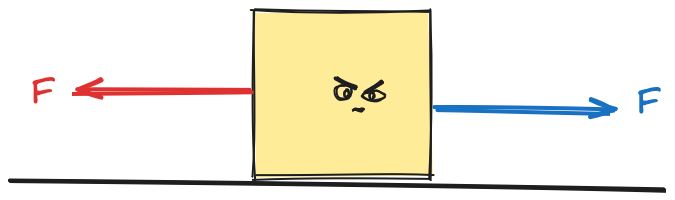
With things like bridges, roads, and buildings this (usually) means the object is not moving, and will continue not to move. Trouble arises when the forces are no longer balanced, and things start to move.
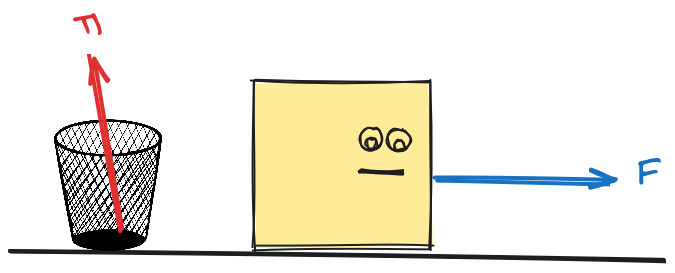
But what happens when if do want Mr. Box to move? What happens when we remove one of the forces on purpose?
Calculating Work using Force
Now that the forces are no longer balanced, Mr. Box will be allowed to accelerate. How much he accelerates depends on how long (in length) the force is applied for. We call this: doing work on Mr. Box. To calculate the amount of work done, we multiply the amount of force (in Newtons) by the length (in meters) the force is applied. The unit for work is Newton-meter, or Joule.
 Example

If you were to pull Mr. Box with a force of 10 Newtons for a length of 1 meter, you will have done 10 Joules of work on Mr. Box.
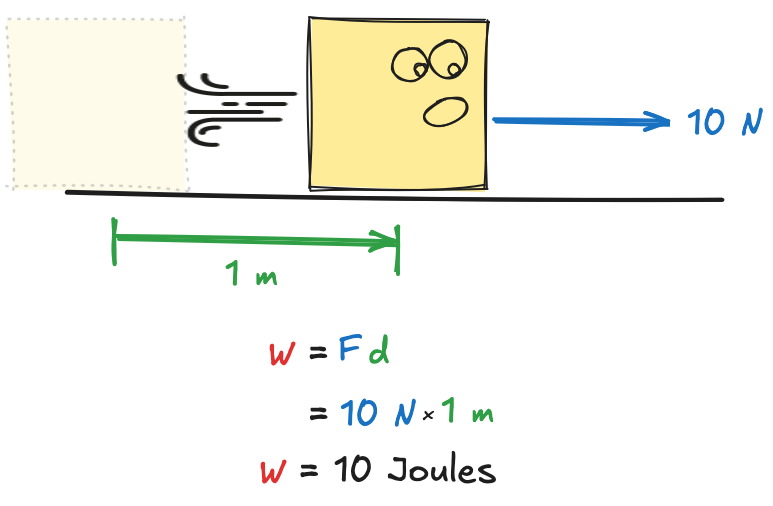
Note: Similar to our working calculating Stress and Strain, it is important to always use proper units when calculating work. For example, 200 cm should be converted to 2 m, 2 kN should be converted to 2,000 N, etc.
Calculating Work using Energy
Previously, we discussed the different types of energy, mainly kinetic and potential. Alternatively, you may calculate the work performed on an object using its change in total energy.
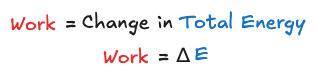
Note: In math, the symbol Δ (or delta) is typically used as a shorthand to say "change in". For example, ΔE is a short way of saying "change in energy."