Mechanical Advantage
Mechanical advantage is a measure of the force amplification achieved by using a tool, mechanical device or machine system. This is calculated as the ratio between the input force, and the output force of the device/tool.
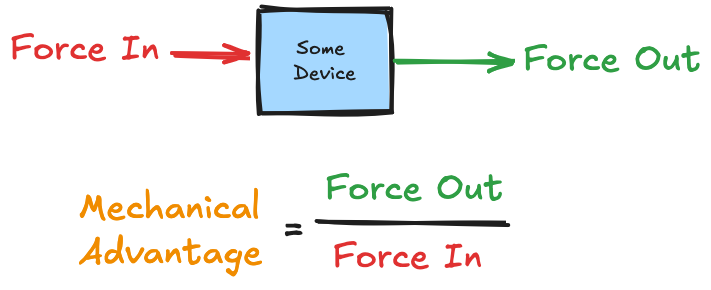
For example, "Some Device" that is able to turn a 10 N input force into a 20 N output force is said to have a mechanical advantage of 2.
NOTE: Because mechanical advantage is a ratio, it does not have a unit.
Simple Machines
Typically, we will achieve mechanical advantage by employing simple machines. A simple machine is a mechanical device that changes the direction and/or magnitude of a force and come in a few varieties.
Inclined Plane
An inclined plane, also known as a ramp, is a flat supporting surface tilted at an angle from the vertical direction, with one end higher than the other, used as an aid for raising or lowering a load.
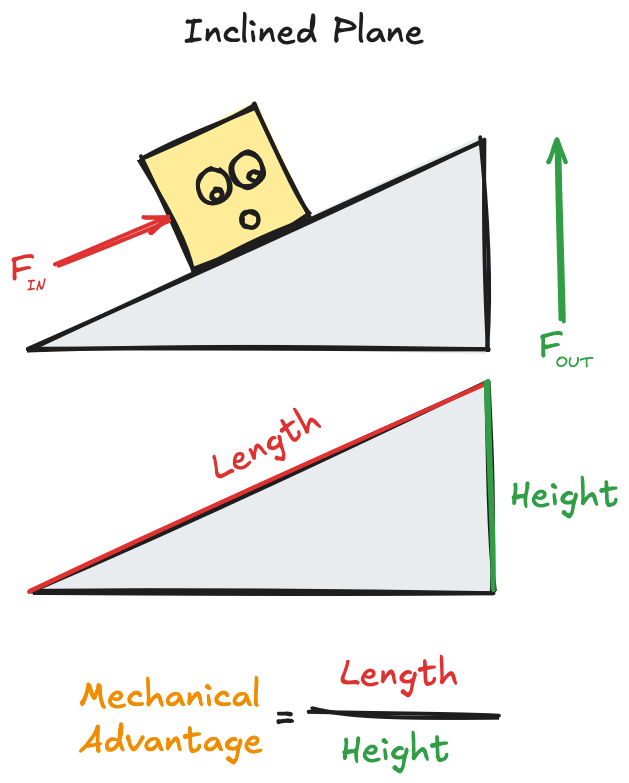
Examples: Ramps, slides, roofs
Levers
A lever is a simple machine consisting of a beam or rigid rod pivoted at a fixed hinge, or fulcrum. Levers are then classified by the relative positions of the fulcrum, input, and output forces.
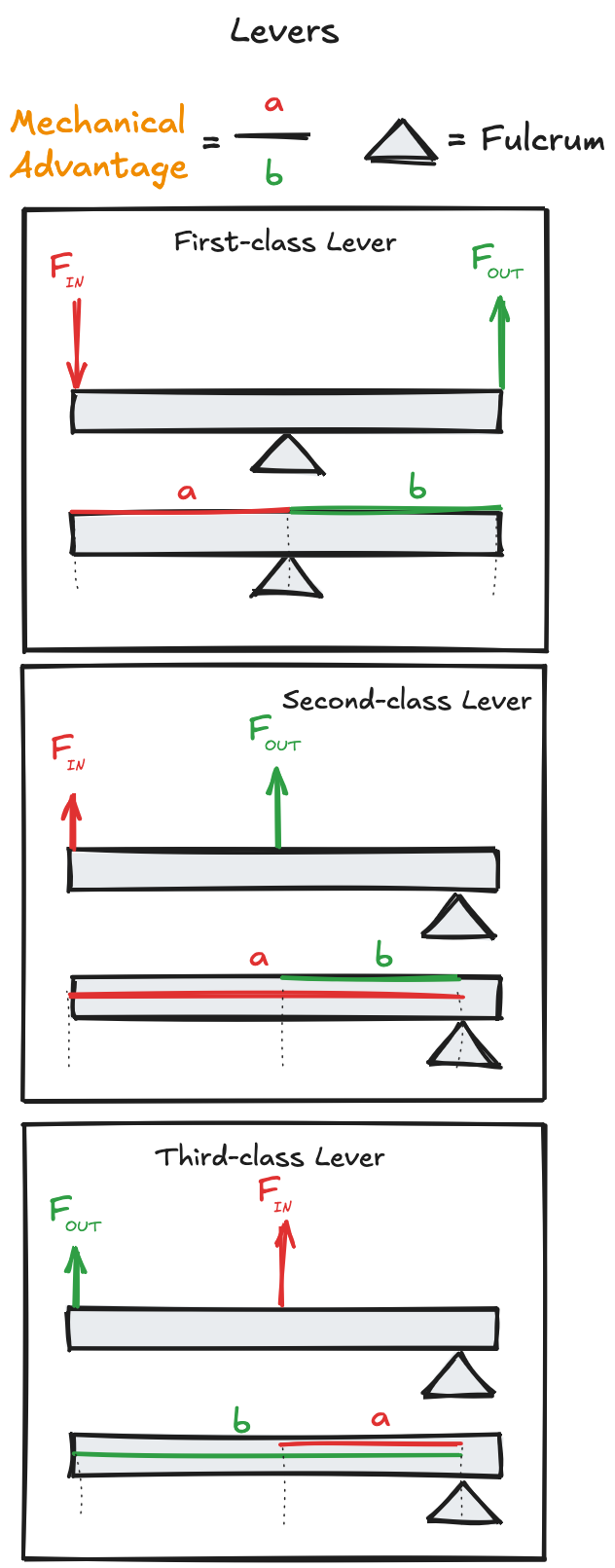
Examples: See-saws (first-class), wheelbarrows (second-class), fishing rod (third-class)
Wedge
A wedge is a triangular shaped tool that is typically used to separate two objects or portions of an object. It can also be used to hold objects in place, and resembles a portable inclined plane.
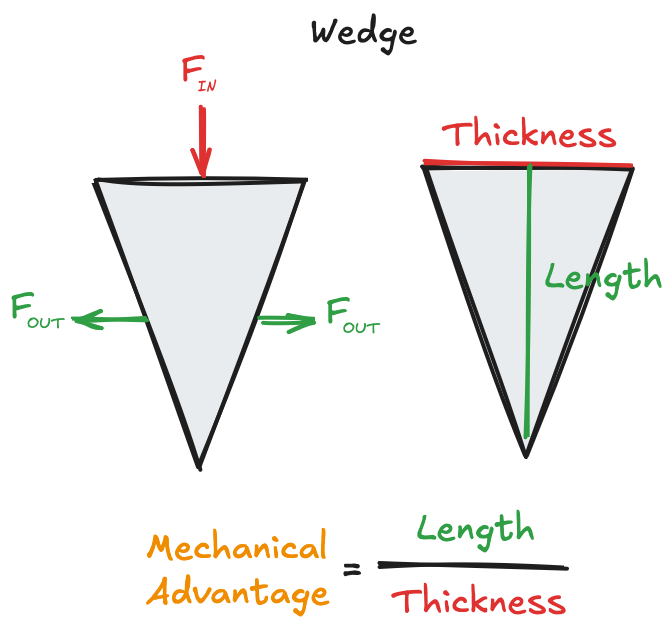
Examples: Axes, door-stoppers, knives
Wheel & Axle
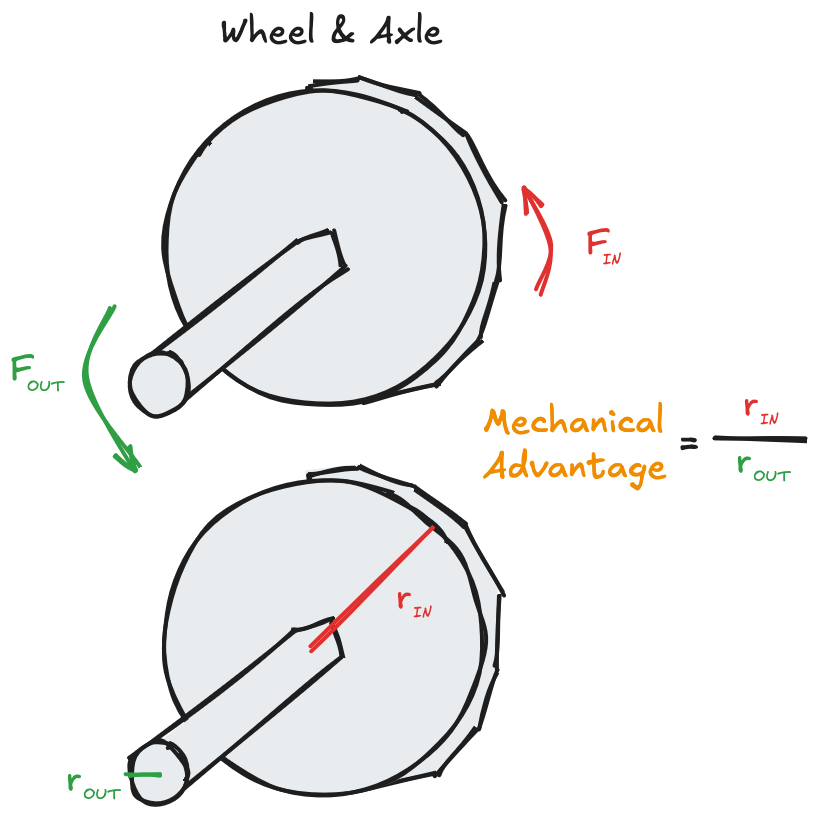
The wheel and axle is a simple machine, consisting of a wheel attached to a smaller axle so that these two parts rotate together, in which a force is transferred from one to the other. The wheel and axle can be viewed as a version of the lever, with a drive force applied tangentially to the perimeter of the wheel, and a load force applied to the axle supported in a bearing, which serves as a fulcrum.