Mr. Box, who has a mass of **10 kilograms (kg)**, is sliding on a patch of ice at **2 meters per second (m/s)** of velocity. How much **kinetic energy** would he have?
[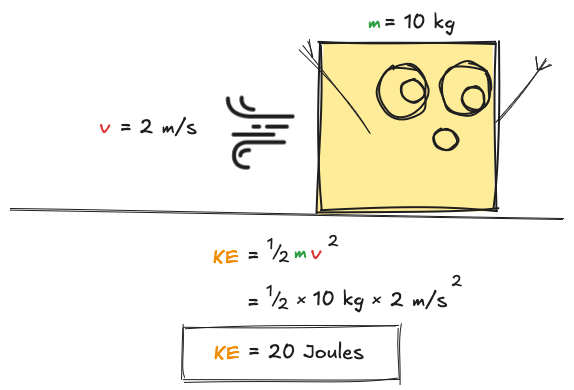](https://bookstack.thebetalab.org/uploads/images/gallery/2026-06/l6yimage.png)Mr. Box would have **20 Joules** of **Kinetic Energy**.
### Potential **Potential energy** is the energy of an object or system due to its position relative to other objects. #### Gravitational **Gravitational potential energy** is calculated using an object's position within a gravitational field. Typically, this is considered to be the **height** (**h**) above the surface of the earth, which provides a constant **gravitational acceleration** (**g**) of around 9.8 meters per second squared. ##### [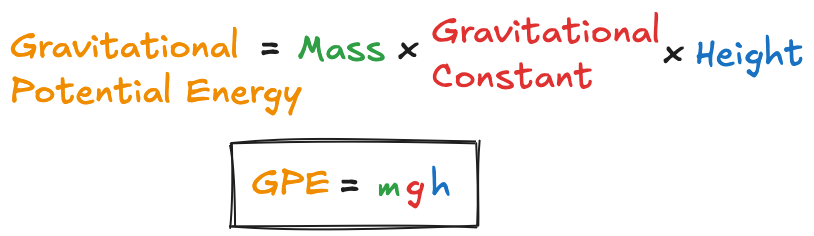](https://bookstack.thebetalab.org/uploads/images/gallery/2026-06/8nhimage.png)ExampleMr. Box, who has a **mass** of **10 kg**, is lifted **5 meters** into the air above the surface of the Earth, which provides a **gravitational acceleration** of **9.8 meters per second** **squared**. How much **gravitational potential energy** would Mr. Box have?
[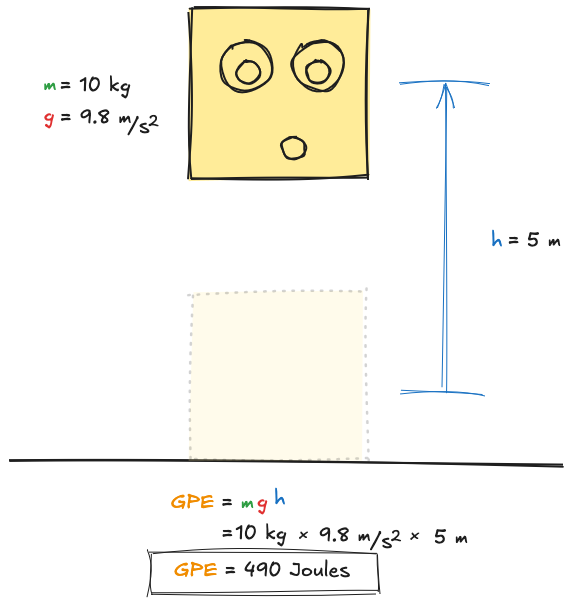](https://bookstack.thebetalab.org/uploads/images/gallery/2026-06/QCFimage.png)Mr. Box would have **490 Joules** of **gravitational potential energy**.
#### Elastic Potential Although similar to gravitational potential energy, **elastic potential energy** instead deals with the energy provided by a spring (or elastic) rather than gravity. A spring's constant (**k**), also known as "stiffness", is determined by its **shape** and **material**. [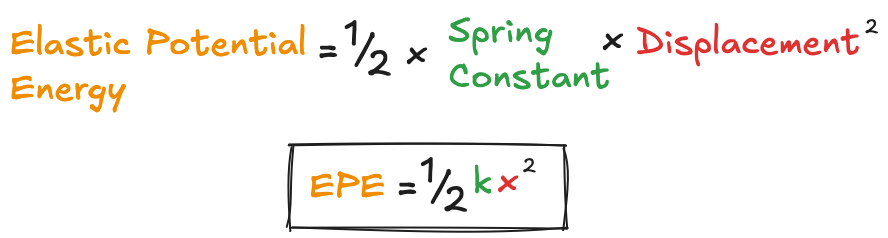](https://bookstack.thebetalab.org/uploads/images/gallery/2026-06/VIwimage.png) ##### ExampleMr. Box (**mass** of **10 kg**) is pressed against a spring with a spring constant of **1 N/m** for **10 centimeters** (or **0.1 meters**). How much **elastic potential energy** does Mr. Box now have?
[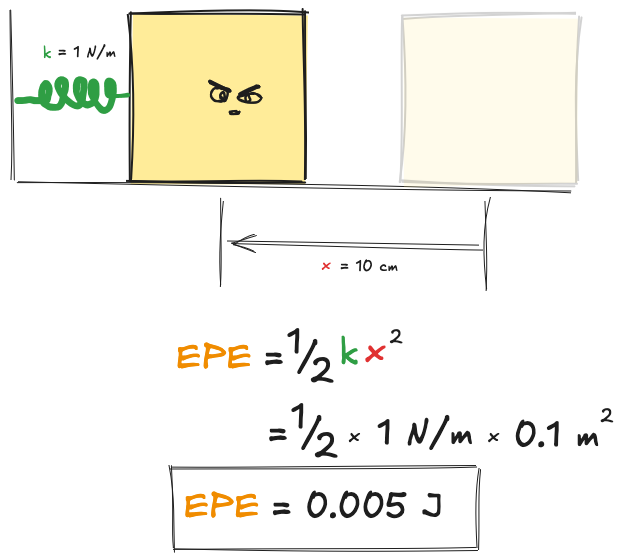](https://bookstack.thebetalab.org/uploads/images/gallery/2026-06/sZ3image.png)Mr. Box would have an **elastic potential energy** of **0.005 Joules**.
## Conservation of Energy The conservation of energy is a fundamental principle of physics, which states: > The **total energy** of an isolated system is **constant** despite internal changes. What this means within the context of our work in mechanical engineering is that the **type** **of energy** a system experiences may change, but the total amount of energy in that system will not. For example:In a previous question, we lifted Mr. Box (mass of **10 kg**) to a height of **5 meters,** which gave him a gravitational potential energy of **490 Joules**. Dropping him from that height would begin to **convert** the **potential energy** into **kinetic energy**. When Mr. Box gets back to the ground (height of **0 meters**) his potential energy will have been entirely converted to kinetic energy.
[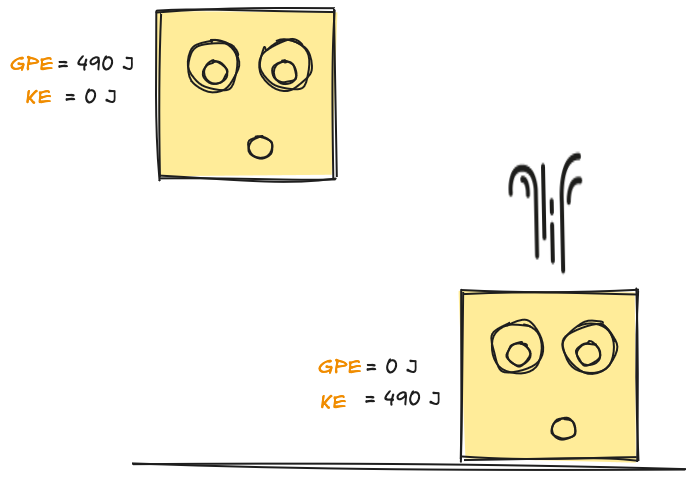](https://bookstack.thebetalab.org/uploads/images/gallery/2026-06/zD6image.png)How much **velocity** is he moving with when he hits the ground (**GPE = 0 J, KE = 490 J**)?
[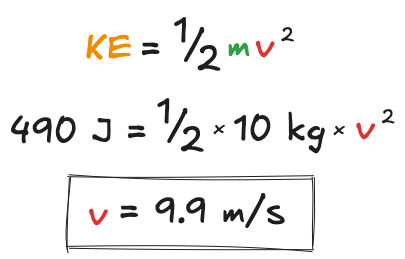](https://bookstack.thebetalab.org/uploads/images/gallery/2026-06/PGAimage.png)