Mr. Box, who has a mass of **10 kilograms (kg)**, is sliding on a patch of ice at **2 meters per second (m/s)** of velocity. How much **kinetic energy** would he have?
[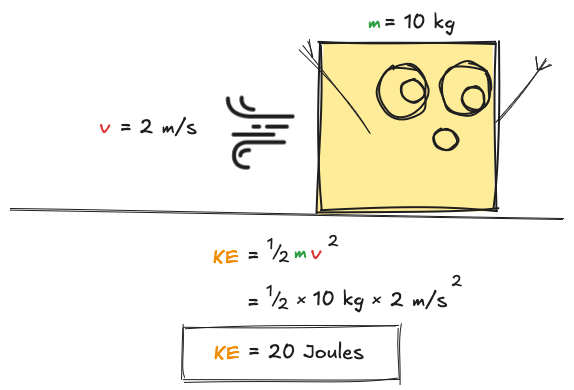](https://bookstack.thebetalab.org/uploads/images/gallery/2026-06/l6yimage.png)Mr. Box would have **20 Joules** of **Kinetic Energy**.
### Potential **Potential energy** is the energy of an object or system due to its position relative to other objects. #### Gravitational **Gravitational potential energy** is calculated using an object's position within a gravitational field. Typically, this is considered to be the **height** (**h**) above the surface of the earth, which provides a constant **gravitational acceleration** (**g**) of around 9.8 meters per second squared. ##### [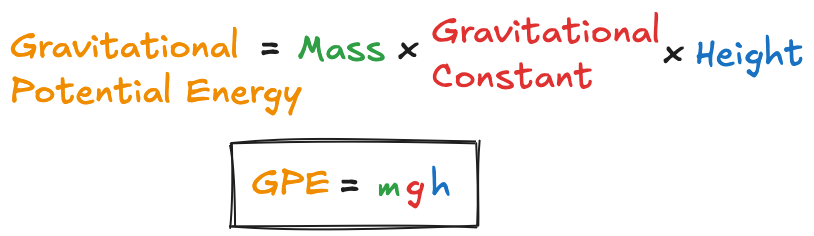](https://bookstack.thebetalab.org/uploads/images/gallery/2026-06/8nhimage.png)ExampleMr. Box, who has a **mass** of **10 kg**, is lifted **5 meters** into the air above the surface of the Earth, which provides a **gravitational acceleration** of **9.8 meters per second** **squared**. How much **gravitational potential energy** would Mr. Box have?
[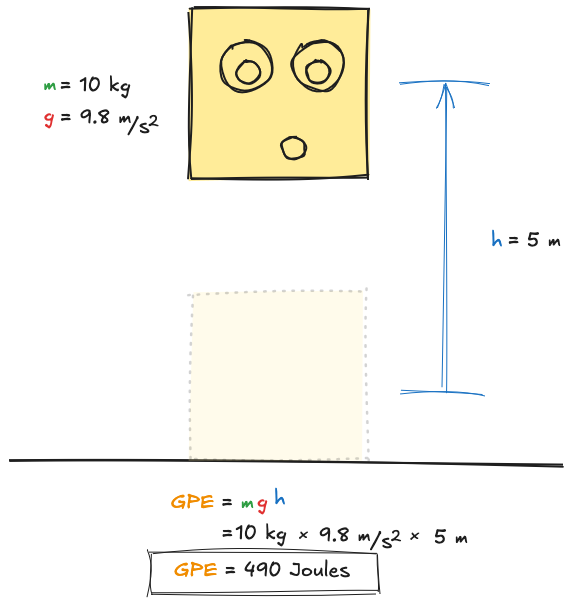](https://bookstack.thebetalab.org/uploads/images/gallery/2026-06/QCFimage.png)Mr. Box would have **490 Joules** of **gravitational potential energy**.
#### Elastic Potential Although similar to gravitational potential energy, **elastic potential energy** instead deals with the energy provided by a spring (or elastic) rather than gravity. A spring's constant (**k**), also known as "stiffness", is determined by its **shape** and **material**. [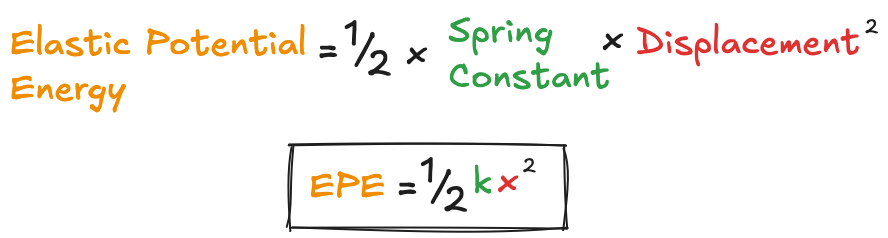](https://bookstack.thebetalab.org/uploads/images/gallery/2026-06/VIwimage.png) ##### ExampleMr. Box (**mass** of **10 kg**) is pressed against a spring with a spring constant of **1 N/m** for **10 centimeters** (or **0.1 meters**). How much **elastic potential energy** does Mr. Box now have?
[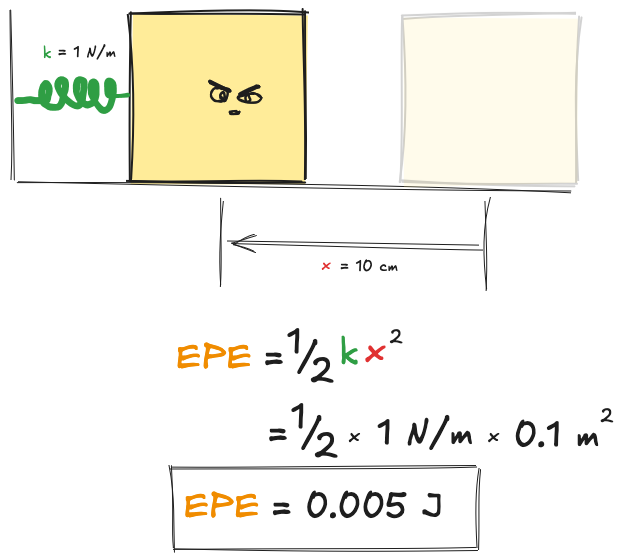](https://bookstack.thebetalab.org/uploads/images/gallery/2026-06/sZ3image.png)Mr. Box would have an **elastic potential energy** of **0.005 Joules**.
## Conservation of Energy The conservation of energy is a fundamental principle of physics, which states: > The **total energy** of an isolated system is **constant** despite internal changes. What this means within the context of our work in mechanical engineering is that the **type** **of energy** a system experiences may change, but the total amount of energy in that system will not. For example:In a previous question, we lifted Mr. Box (mass of **10 kg**) to a height of **5 meters,** which gave him a gravitational potential energy of **490 Joules**. Dropping him from that height would begin to **convert** the **potential energy** into **kinetic energy**. When Mr. Box gets back to the ground (height of **0 meters**) his potential energy will have been entirely converted to kinetic energy.
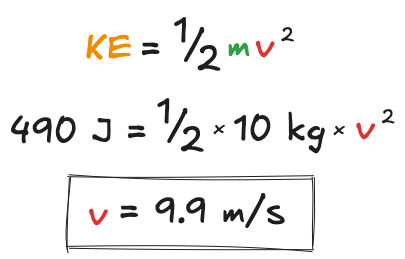
[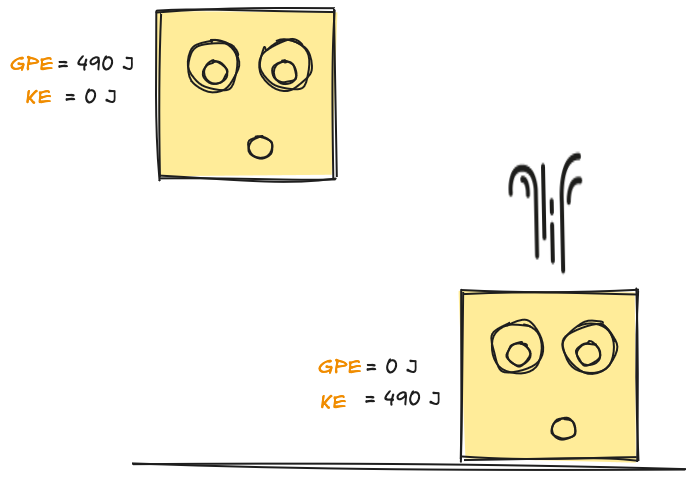](https://bookstack.thebetalab.org/uploads/images/gallery/2026-06/zD6image.png)How much **velocity** is he moving with when he hits the ground (**GPE = 0 J, KE = 490 J**)?
[](https://bookstack.thebetalab.org/uploads/images/gallery/2026-06/PGAimage.png) # Work #### Background In the previous unit on [Civil Engineering](https://bookstack.thebetalab.org/books/principles-of-engineering/chapter/civil-engineering "Civil Engineering"), we discussed the principle of [**force**](https://bookstack.thebetalab.org/books/principles-of-engineering/page/types-of-forces "Types of Forces"), and the idea that:When the forces acting on Mr. Box add up to zero, he will not accelerate.
[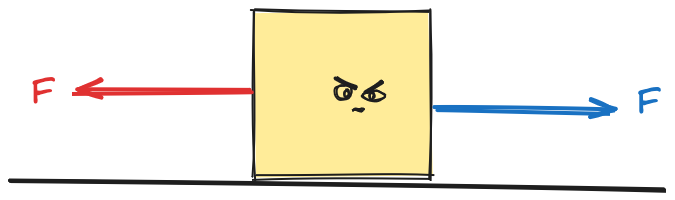](https://bookstack.thebetalab.org/uploads/images/gallery/2026-06/JOPimage.png) With things like bridges, roads, and buildings this (usually) means the object is not moving, and will continue not to move. Trouble arises when the forces are no longer balanced, and [things start to move](https://youtu.be/XggxeuFDaDU?si=q4kutyfasevKj5s0). But what happens when if ***do*** want Mr. Box to move? What happens when we remove one of the forces ***on purpose***? [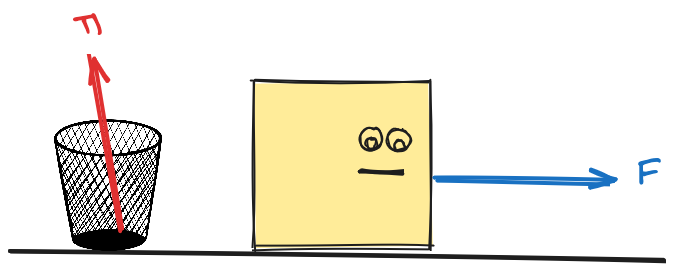](https://bookstack.thebetalab.org/uploads/images/gallery/2026-06/aEKimage.png) #### Calculating Work using Force Now that the forces are no longer balanced, Mr. Box will be allowed to **accelerate**. How much he accelerates depends on how long (in length) the force is applied for. We call this: ***doing work on Mr. Box***. To calculate the amount of work done, we multiply the amount of force (in Newtons) by the length (in meters) the force is applied. The unit for work is Newton-meter, or **Joule**. ##### [](https://bookstack.thebetalab.org/uploads/images/gallery/2026-06/7Awimage.png)Example If you were to pull Mr. Box with a force of **10 Newtons** for a length of **1 meter**, you will have done **10 Joules** of work on Mr. Box. [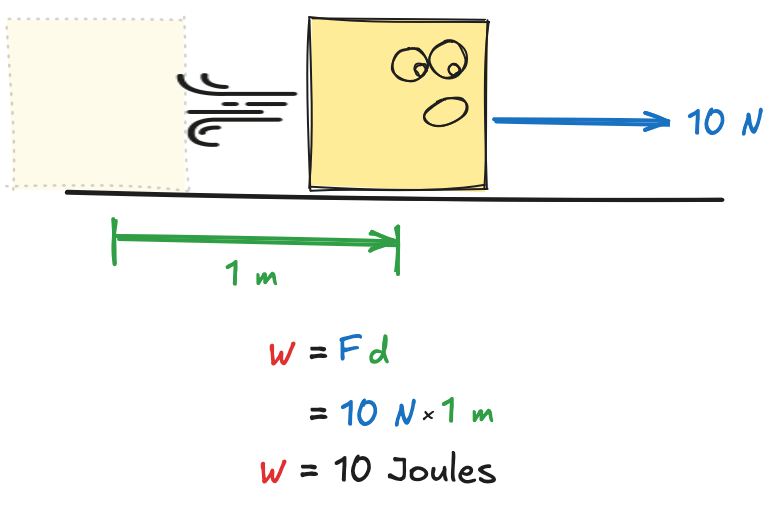](https://bookstack.thebetalab.org/uploads/images/gallery/2026-06/013image.png)**Note**: Similar to our working calculating [Stress and Strain](https://bookstack.thebetalab.org/books/principles-of-engineering/page/stress-and-strain "Stress and Strain"), it is important to always use proper units when calculating work. For example, **200 cm** should be converted to **2 m**, **2 kN** should be converted to **2,000 N**, etc.
#### Calculating Work using Energy Alternatively, you may calculate the work performed on an object using its **change in total energy.** [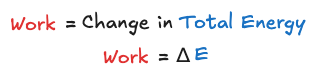](https://bookstack.thebetalab.org/uploads/images/gallery/2026-06/e0Limage.png)**Note**: In math, the symbol **Δ** (or **delta**) is typically used as a shorthand to say "change in". For example, **ΔE** is a short way of saying "change in energy."
[Previously](https://bookstack.thebetalab.org/books/principles-of-engineering/page/energy "Energy"), we discussed the different types of energy, such as **kinetic** and **potential.** When an object changes the total energy of another object, it is said to have done **work** on that object. ##### ExamplesYou lift Mr. Box (10 kg) in the air. Originally his **gravitational potential energy** was **0 Joules**. By raising him in the air **0.98 meters**, you have done **100 Joules** of **work** on him.
[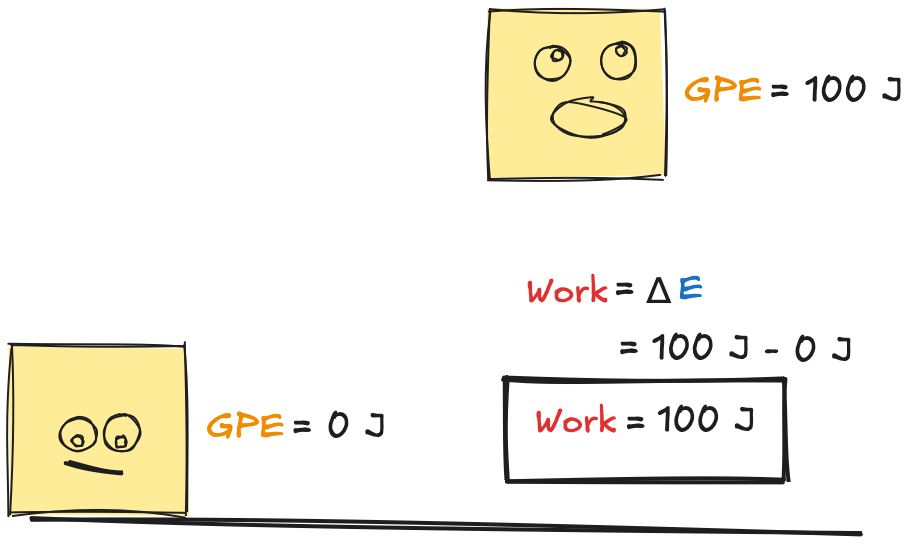](https://bookstack.thebetalab.org/uploads/images/gallery/2026-06/qNMimage.png) This can also apply to changes in **kinetic energy**:Mr. Box is sliding with **50 Joules** of **kinetic energy**. He hits a wall that brings him to a stop (**0 Joules**). The wall did **50 Joules** of work on **Mr. Box**.
[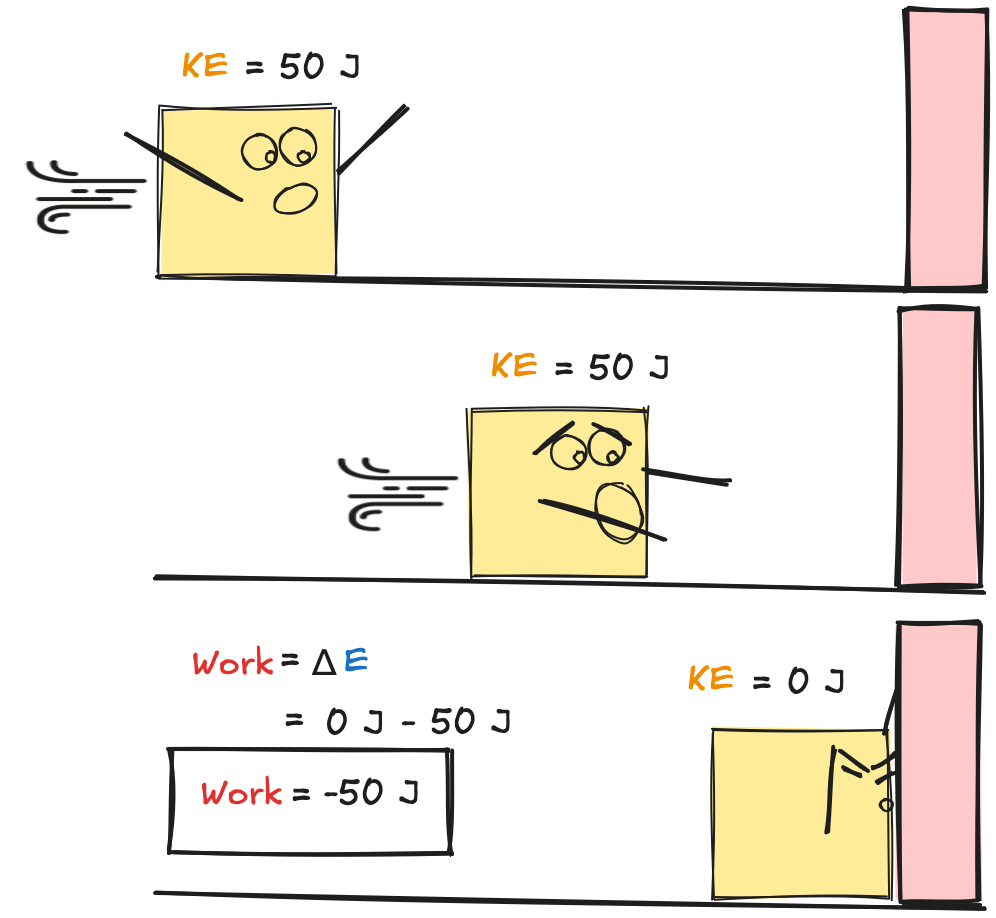](https://bookstack.thebetalab.org/uploads/images/gallery/2026-06/izeimage.png)**NOTE**: The work is **negative** because the wall is **taking energy away** from Mr. Box.
# Mechanical Advantage **Mechanical advantage** is a measure of the force **amplification** achieved by using a tool, mechanical device or machine system. This is calculated as the ratio between the input force, and the output force of the device/tool. [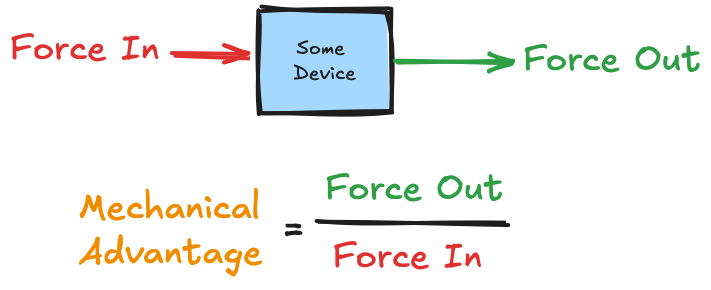](https://bookstack.thebetalab.org/uploads/images/gallery/2026-06/cavimage.png)For example, "Some Device" that is able to turn a **10 N input force** into a **20 N output force** is said to have a mechanical advantage of **2**.
**NOTE**: Because **mechanical advantage** is a **ratio**, **it does not have a unit**.
### Simple Machines Typically, we will achieve mechanical advantage by employing **simple machines**. A **simple machine** is a mechanical device that changes the direction and/or magnitude of a force and come in a few varieties. #### Inclined Plane An **inclined plane**, also known as a ramp, is a flat supporting surface tilted at an angle from the vertical direction, with one end higher than the other, used as an aid for raising or lowering a load. [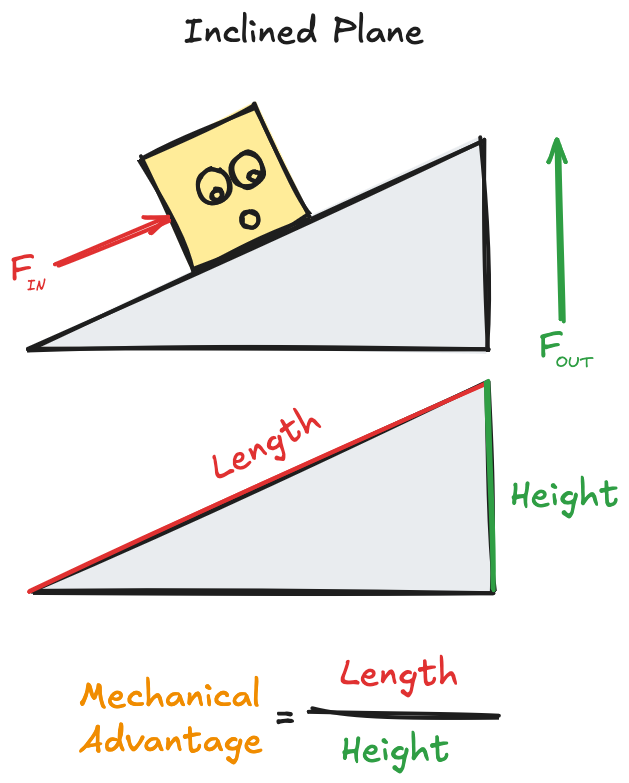](https://bookstack.thebetalab.org/uploads/images/gallery/2026-06/XjKimage.png)**Examples**: Ramps, slides, roofs
#### Levers A **lever** is a simple machine consisting of a beam or rigid rod pivoted at a fixed hinge, or **fulcrum**. Levers are then classified by the relative positions of the fulcrum, input, and output forces. ##### [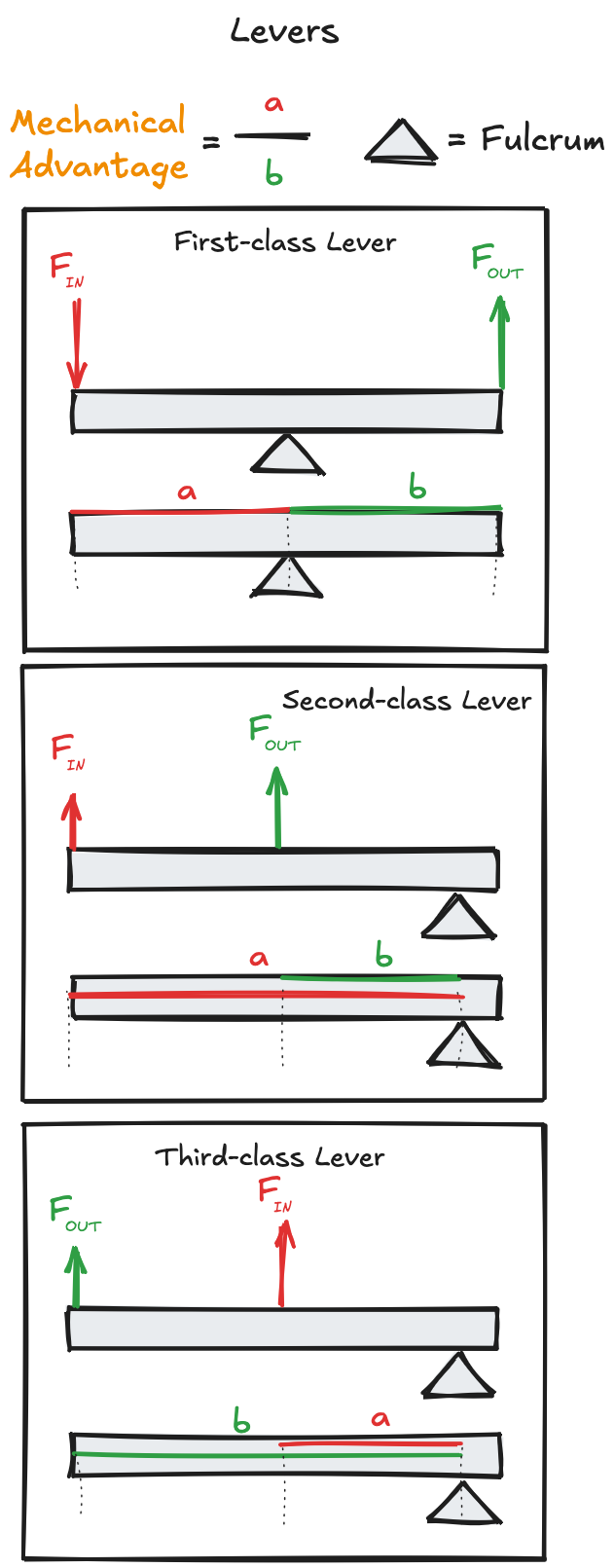](https://bookstack.thebetalab.org/uploads/images/gallery/2026-06/4lFimage.png)**Examples**: See-saws (first-class), wheelbarrows (second-class), fishing rod (third-class)
#### Wedge A **wedge** is a **triangular** shaped tool that is typically used to separate two objects or portions of an object. It can also be used to hold objects in place, and resembles a **portable** **inclined plane**. [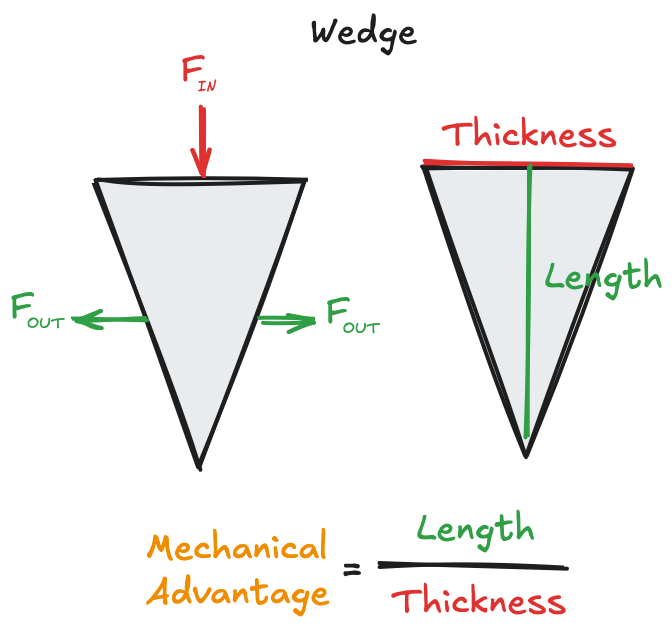](https://bookstack.thebetalab.org/uploads/images/gallery/2026-06/PTaimage.png)**Examples**: Axes, door-stoppers, knives
#### Wheel & Axle The **wheel and axle** is a simple machine, consisting of a **wheel** attached to a smaller **axle** so that these two parts rotate together, in which a force is transferred from one to the other. The **wheel and axle** can be viewed as a version of the **lever**, with a drive force applied tangentially to the perimeter of the wheel, and a load force applied to the axle supported in a bearing, which serves as a **fulcrum**. [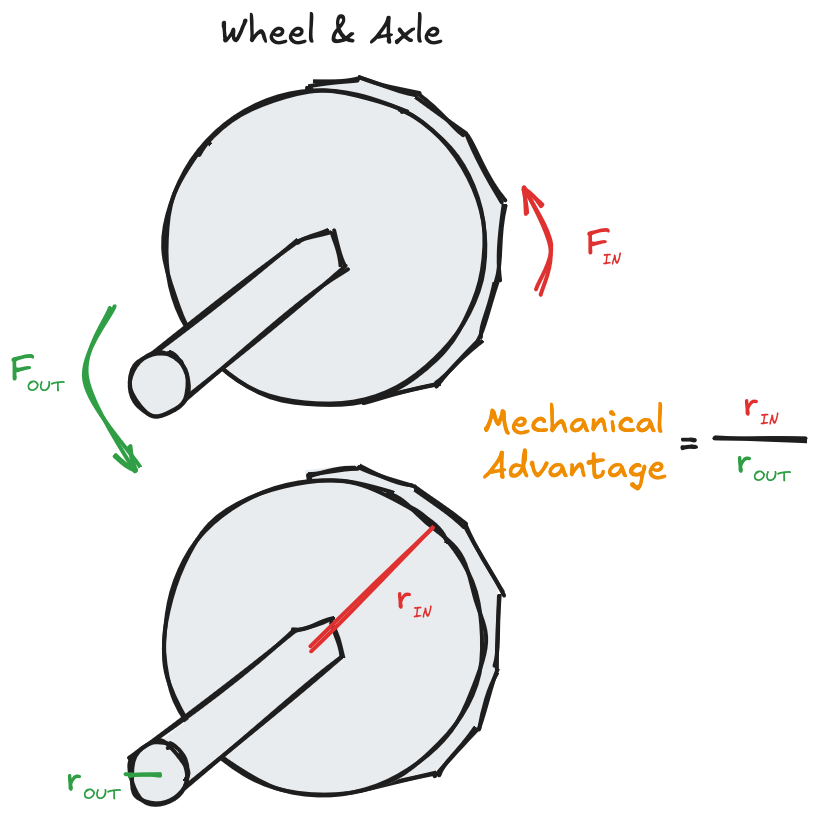](https://bookstack.thebetalab.org/uploads/images/gallery/2026-06/J9Himage.png) #### Screw The **screw** is a simple machine that converts **rotational motion** to **linear motion**, and a torque (rotational force) to a linear force. The amount of mechanical advantage achieved by a screw depends on both the input radius, and the pitch length. The **input radius** is considered to be the distance from where the force is applied, to the axis around which the screw spins. The pitch length is the distance between each threads of the screw, or how long the screw has moved after one rotation. [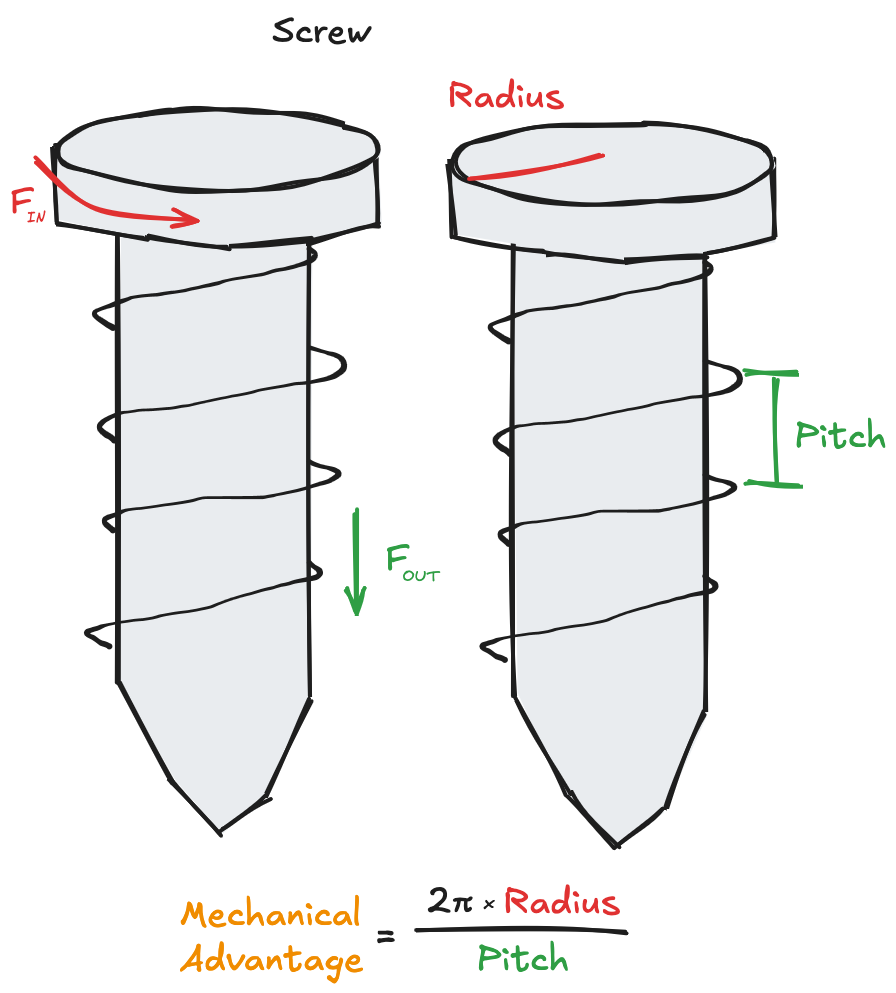](https://bookstack.thebetalab.org/uploads/images/gallery/2026-06/aazimage.png) ### Other Types of Machines Up until this point, we have discussed simple machines which are well... simple. They are comprised of very few parts -- sometimes only one. There are also machines that, by their nature, require (at least) a few moving parts to achieve mechanical advantage. #### Gears #### Pulleys ### Conservation of Energy An important thing to note when dealing with simple machines # Collisions**Learning** **Outcome**: Identify whether a collision is **elastic** or **inelastic**, and calculate the velocities of the objects involved before and after.
# Machine Elements**Learning Outcome:** Identify various machine elements, describe their function, and include them in the construction of simple and complex machines.
## Fasteners A **fastener** is a machine element that joins or affixes two or more objects together. Some fasteners do this using chemical properties (like glue), or heat (like soldering), but this page will focus specifically on **mechanical fasteners.**A **mechanical fastener** holds two (or more) pieces together using the [mechanical advantage of a simple machine](https://bookstack.thebetalab.org/books/principles-of-engineering/page/mechanical-advantage). In order to separate the pieces, the simple machine must be overcome or undone.
#### Nails A **nail** is a (typically) metal device that is driven through two (or more) pieces, acting as a wedge and using friction to keep them fastened together. [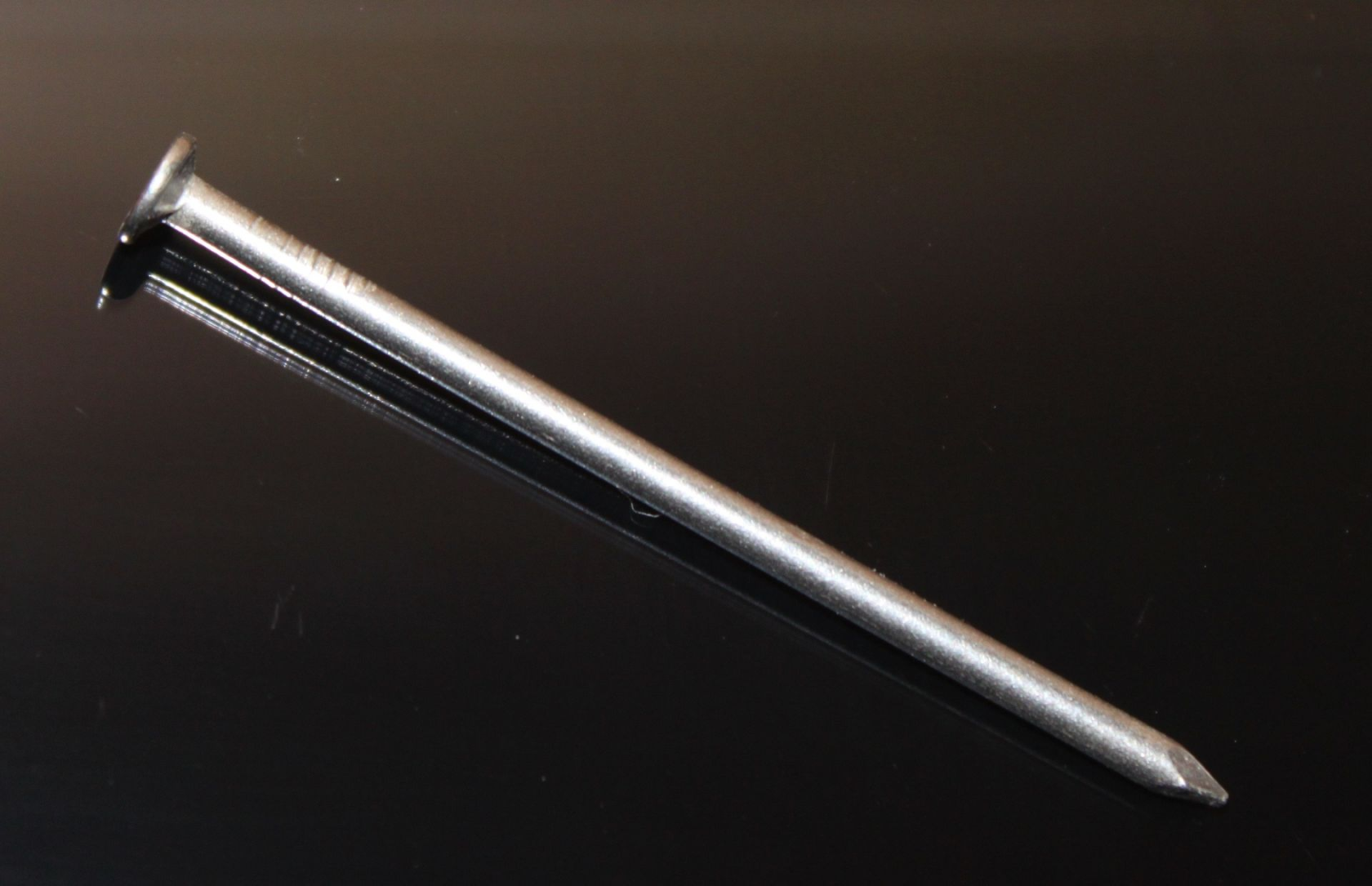](https://bookstack.thebetalab.org/uploads/images/gallery/2026-04/Ztuimage.png)| **Name** | **Description** | **Example** | |
| Nail |
| ||
| Screw | [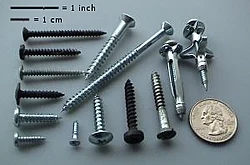](https://bookstack.thebetalab.org/uploads/images/gallery/2026-04/mIVimage.png) | ||
| Bolt | [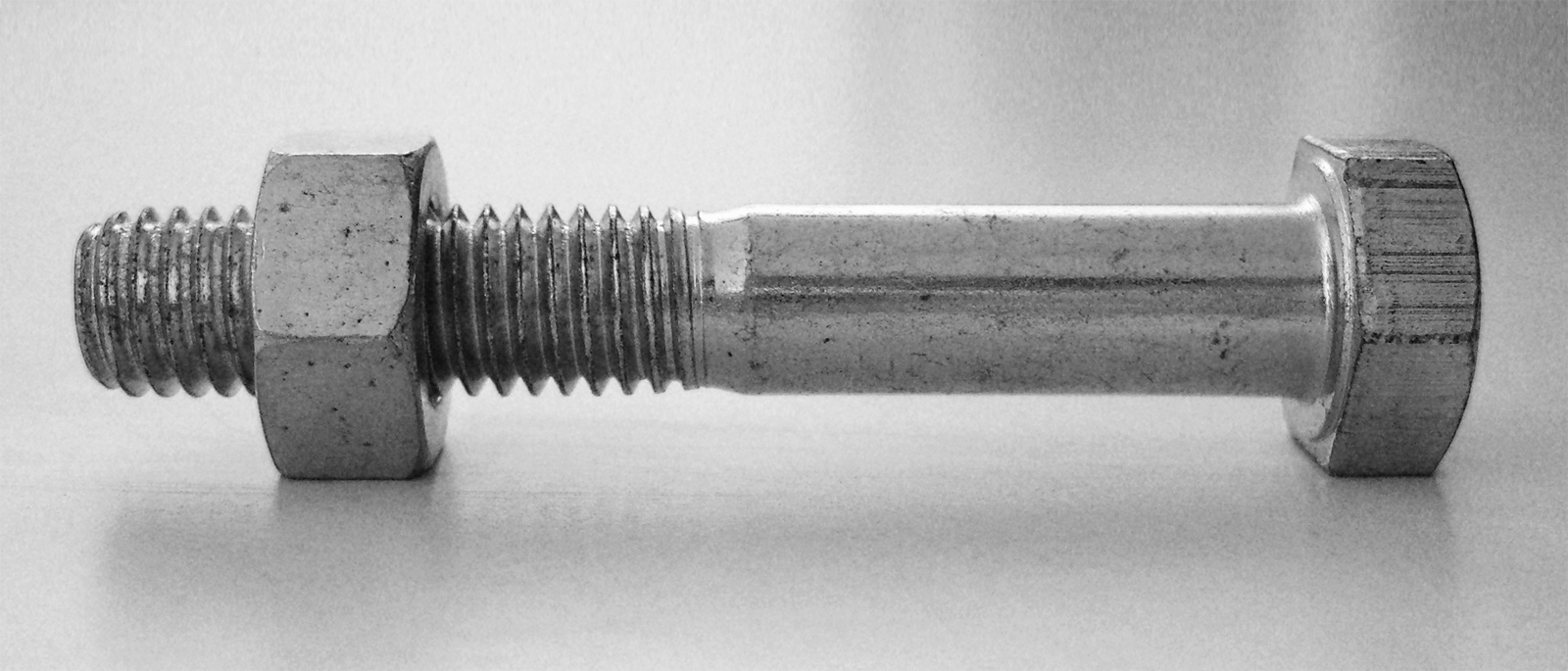](https://bookstack.thebetalab.org/uploads/images/gallery/2026-04/bNkimage.png) |
**Screws** fasten objects together **on their own**.
**Bolts** fasten objects together with the **help of a [nut](#bkmrk-nuts) on the other side**.
The *[Machinery's Handbook](https://en.wikipedia.org/wiki/Machinery%27s_Handbook "Machinery's Handbook")* describes the distinction between bolts and screws in more detail: > A bolt is an externally threaded fastener designed for insertion through holes in assembled parts, and is normally intended to be tightened or released by torquing a nut. A screw is an externally threaded fastener capable of being inserted into holes in assembled parts, of mating with a preformed internal thread or forming its own thread, and of being tightened or released by torquing the head. An externally threaded fastener which is prevented from being turned during assembly and which can be tightened or released only by torquing a nut is a bolt. (Example: round head bolts, track bolts, plow bolts.) An externally threaded fastener that has thread form which prohibits assembly with a nut having a straight thread of multiple pitch length is a screw. (Example: wood screws, tapping screws.)[\[60\]](https://en.wikipedia.org/wiki/Screw#cite_note-60) #### Screws**NOTE**: We are talking here about **screws** as a **physical machine element**, rather than a theoretical [simple machine screw](https://bookstack.thebetalab.org/books/principles-of-engineering/page/simple-and-complex-machines "Simple and Complex Machines").
Contrary to [Nails](#bkmrk-nails) which rely solely on friction to fasten two pieces together, **screws** use the mechanical advantage provided by their threading. They come in a wide variety types and sizes. Which you choose varies drastically depending #### Bolts [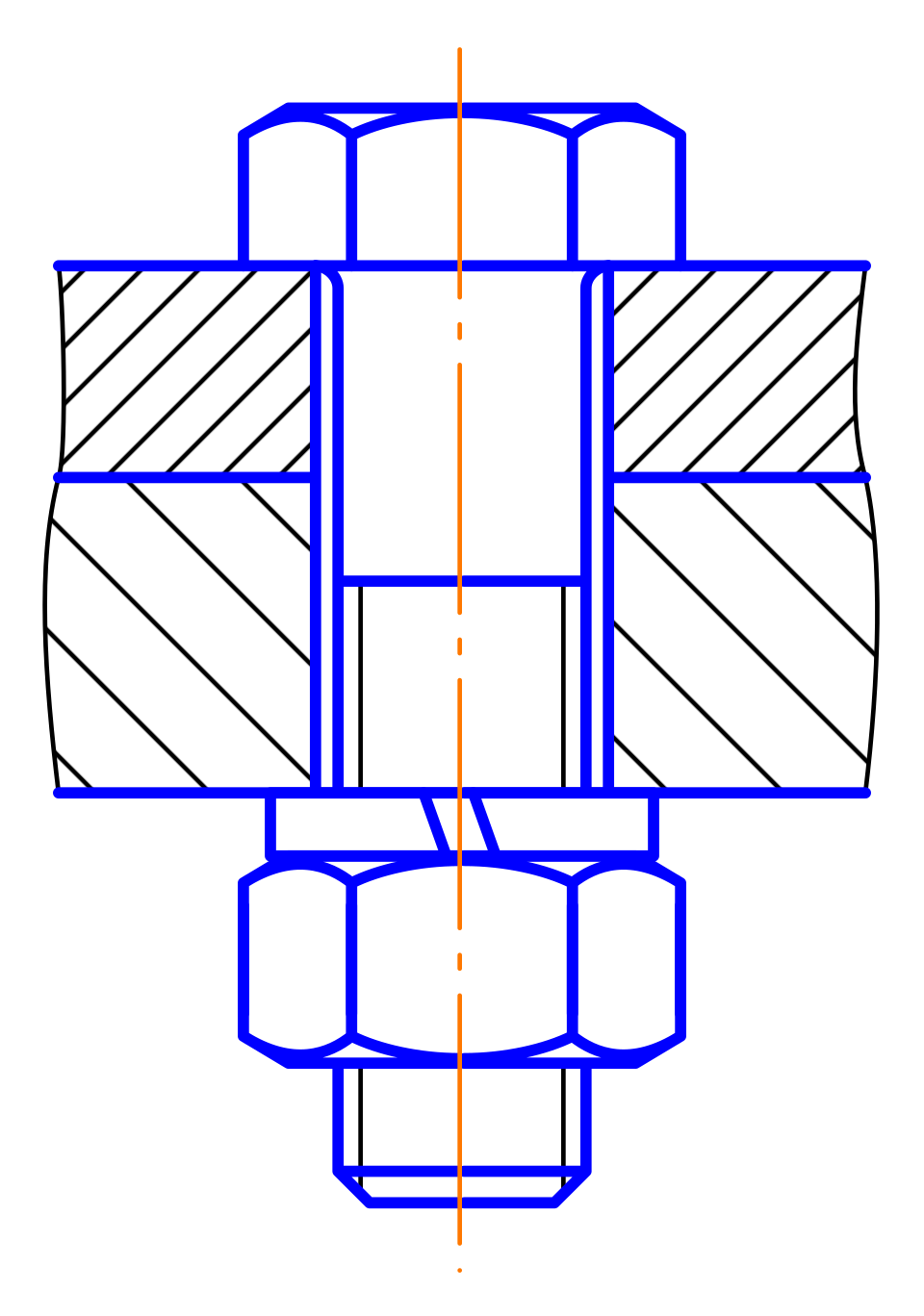](https://bookstack.thebetalab.org/uploads/images/gallery/2026-04/STFimage.png) #### Nuts When combined with a [Bolt](#bkmrk-screws), ## Shafts ## Bearings A **bearing** is a machine element ####